Twenty years after the rebellion lost, a reluctant new revolutionary makes a deal with a dangerous enemy to save her friends. Together, they’ll rescue their empire. Or destroy it.
Here’s the cover of The King Must Die, my new novel about friendship, second chances, and facing tyranny with collective action. The incredible artist, Eleonor Piteira, included a bunch of little details from the book.
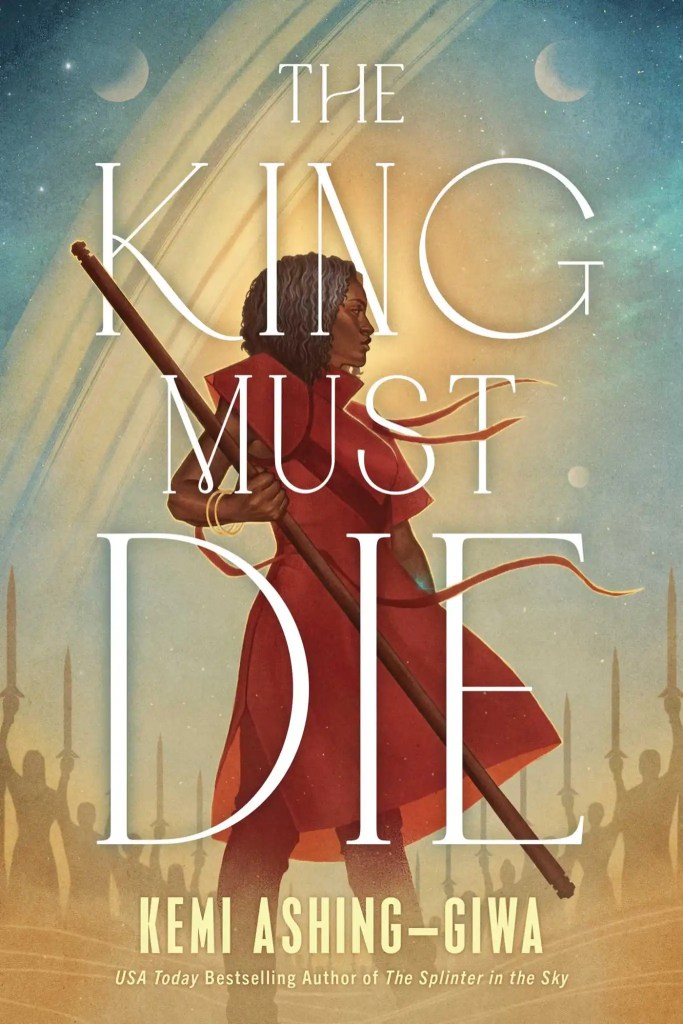
Preorders really are as critical as everyone says; publishers keep track of how many times a book is preordered, and then adjust how much they’re going to support the book based on those figures. If you do buy an early copy, I suggest holding onto your receipts, as there may or may not be rewards down the road…
Okay. Now that I’ve been good and done some obligatory marketing, I can talk about other stuff. The 2025 fundraiser for Locus Magazine—the oldest, longest-running SFF journal—is live! If you love all things sci-fi, fantasy, and horror, take a look. In addition to deleted scenes and commissioned art from This World Is Not Yours (available as a thank you gift for any donation), I’m offering (separately) a one-on-one Zoom chat and a signed, personalized, first edition paperback copy of The Splinter in the Sky. It is one of only five author copies I have left; the others have already been donated or burned with the rest of my stuff in the Eaton fire.
I’m also donating one of those copies to the Genre Creators for Trans Rights in the United Kingdom and South Africa auction, which was organized after the dehumanizing UK Supreme Court ruling in April. After this, I’ll be down to three paperbacks, and I’m probably gonna hold onto those. So if you want one, these are your last chances! Forever!
***
What I’ve been reading lately:
- Emperor of Rome: Ruling the Ancient World by Mary Beard. My annual ancient history hyperfixation has reared its head, so I’m picking this book back up. (I was enjoying it when I first put it back on the digital shelf, I just knew I’d like it even more later.)
- The World: A Family History of Humanity by Simon Sebag Montefiore. Two and a half acts to go before I finish this magnificent behemoth!
- Making History by K.J. Parker. Given all the similarities in theme and style, I should’ve recognized that Parker also wrote “Set in Stone,” one of the best short stories I read last year, but I didn’t until I looked up the author. Keep an eye out for this when it hits shelves in September!
Some of what I’ve read recently:
- “Five Views of the Planet Tartarus” by Rachael K. Jones. A clever and brutal piece of flash fiction.
- Banned Book Club by Kim Hyun Sook. Set during South Korea’s Fifth Republic, this graphic novel follows a literature major who tries to avoid the chaos of both her family restaurant and escalating student protests by escaping into books. However, as she soon discovers, everything is political, and resistance dies not simply through state violence but through silence.
- Slow Violence and the Environmentalism of the Poor by Ron Nixon. I’ve been slowly whittling down my TBR over the past few years. Since I’ve become extremely picky, I’ve been reading faster than I’ve been adding titles, which is a problem. So I’ve been asking all my good friends for their favorite books and trying those out. My dear pal Andrea said this was her top recommendation of all time, and having finished it, I can see why. Slow Violence is an incredible, empathetic piece of nonfiction that pays special attention to the terrible devastation of environmental degradation on the global South and on women. It reminded me a lot of Derrick Jensen’s phenomenal The Myth of Human Supremacy, which is Slow Violence’s nonhuman-focused, scientific cousin. I mean, I study mass extinctions and their kill mechanisms for a living. I knew climate change was bad, and I knew it disproportionately impacted African and South American countries. I just didn’t know the level of mustache-twirling greed that went on behind the scenes to keep us on the same destructive path we’re on, and I knew very little about just how horribly complicit even our most “progressive” representatives have been. Here are some quotes (and quotes of quotes) from the book, out of order:
“I think the economic logic behind dumping a load of toxic waste in the lowest-wage country is impeccable and we should face up to that… I’ve always thought that countries in Africa are vastly under polluted; their air quality is probably vastly inefficiently low compared to Los Angeles… Just between you and me, shouldn’t the World Bank be encouraging more migration of the dirty industries to the Least Developed Countries?” – Lawrence Summers, confidential World Bank memo, December 12, 1991 (2%)
“It is a pervasive condition of empires that they affect great swathes of the planet without the empire’s populace being aware of that impact—indeed without being aware that many of the affected places even exist. How many Americans are aware of the continuing socio environmental fallout from U.S. militarism and foreign policy decisions made three or four decades ago in, say, Angola or Laos?” (12%)
“Shell operations still impossible unless ruthless military operations are undertaken for smooth economic activities to commence.” – Nigerian government memo, December 5, 1994 (30%)
“In a world permeated by insidious, yet unseen or imperceptible violence, imaginative writing can help make the unapparent appear, making it accessible and tangible by humanizing drawn-out threats inaccessible to the immediate senses. Writing can challenge perceptual habits that downplay the damage slow violence inflicts and bring into imaginative focus apprehensions that elude sensory corroboration… To allay states of apprehension…entails facing the challenge, at once imaginative and scientific, of giving the unapparent a materiality upon which we can act.” (6%)
- Nixon focuses on mainstream/realistic fiction here, but having branched out in my reading from primarily SFF in the past few years, I have to say that the most powerful explorations of climate change and capitalism I’ve read recently have been genre fiction. Few books I’ve encountered capture the ways in which environmental catastrophes shatter societies and exacerbate bigotry as well as N.K. Jemisin’s The Fifth Season, or illustrate the dehumanization of hypercapitalism as sharply as Martha Wells’ The Murderbot Diaries. Obviously I’m biased here, as these are some of my favorite books, but I stand by the point.
- Hedra by Jesse Lonergan. A lone astronaut leaves a world ravaged by nuclear war in search of life. No words, just great art.
- The Cosmic Ballad of Layla and Airy by Mira Ong Chua. A fun sci-fi comic about a treasure hunter, a pop star, and a poorly-worded wish.
- Socialism… Seriously: A Brief Guide to Surviving the 21st Century by Danny Katch. Curious about socialism, its history, what it really means, and how it could work? You might enjoy this introductory book too!
- Numamushi by Mina Ikemoto Ghosh. Thank you, universe, for giving me such great friends. This lovely little book was suggested by my pal and fellow author Julia Vee (check out Ebony Gate), and it scratched the exact literary itch I had at the time. With precise, delicate prose and a tender heart, Numamushi explores family, friendship, and writing. Highly, highly recommended!
- “The Envoy and the Warrior” by Simon Roy. A short, beautiful space opera comic, drawn in a style slightly different from Roy’s other work.
A movie I’ve watched recently:
- Finally, I don’t normally talk about movies and TV on here, but I’m going to be the umpteenth person to tell you that Sinners is amazing. It is, hands down, the best movie I’ve seen since Everything, Everywhere All At Once. I’ve watched it three times in theaters, and discovered something new each time.
 Kemi Ashing-Giwa
Leave a comment