
I do not care about what fictional villains “deserve.”
It’s more important to me whether a character’s arc is well-executed than whether that arc aligns, within the story, with my personal moral beliefs. In “Sunta,”1 an alien parasite hijacks the main character’s body, tries to kill her entire crew, and gets away scot-free. This does not mean I think it’s okay for alien parasites to commandeer bodies. I wrote such an unfair ending intentionally, and the reasons why are hopefully clear by the last line. The point is, just because something’s on the page or in the episode doesn’t mean the creators support it. It’s weird that this even has to be said, but when I was still on Twitter people argued about it every other week. What I do care about is what real people think villains deserve. I care about which characters are seen as redeemable, and why.2
This World Is Not Yours is a story about, simply put, some terrible people. I’d wanted to write a longer story about particularly awful characters for some time. I’m a fan of both redemption and corruption arcs; a not-insignificant fraction of the media I consume centers them. And yet, there are some very obvious trends across nearly all of those stories, with regard to who is (A) forgiven and who is (B) not. Who (A) gets off with a slap on the wrist and a cheeky scolding, and who (B) is violently punished to the sound of uproarious applause. Who (A) lives and who (B) dies. And, when a morally complicated character does perish, whose death is (A) a noble sacrifice and whose demise is (B) a celebrated victory for the true heroes. In mainstream media, Group A is mostly composed of paper-pale men with flowing black hair (Kylo Ren, Loki, Snape, etc., etc.), with precious few exceptions. Group B is everyone else—those who are already seen as fundamentally “corrupted” don’t need corruption arcs, after all, and they rarely get to be redeemed.
Characters that are people of color, queer, or women get punished, even when they aren’t villains. The single black character in a horror film almost always dies first. Lesbians get shot after professing their love, occasionally with mere minutes in between. (I wish this were hyperbole—check out Killing Eve for a textbook example.3) Women are constantly attacked and abused for the sake of the “plot” or “historical accuracy” or even “character development”—not for the women themselves, of course, but for the dashing heroes. I wanted to write a story where these characters aren’t punished for their very existence—or rather, they are punished, but this time, they get to fight back.
The thing is, I could have very easily written the Certified Pure™ versions of my main characters. But minorities are not a monolith, and marginalized people shouldn’t have to be good in order to be seen as human. You can argue, albeit futilely, that fiction does not impact reality. But you cannot deny that fiction reflects reality. Society at large isn’t equally forgiving or understanding of all people. No creator can separate the entirety of the outside world, along with their own personal beliefs and biases, from their work.
If an author ever claims to, just know they’re lying.
Anyway, This World Is Not Yours, my sci-fi horror novella about jealousy, rage, remorse, and a beautiful, murderous, sentient planet, is out in the world today.
***
Events:
- In addition to running my sci-fi worldbuilding workshop (you can enter the lottery for it here), I’m going to be participating in two additional events at Flights of Foundry this year:
- Scientists who Write Science Fiction: I’ll be chatting about sci-fi with other science people during a group discussion on 9/27 at 3PM, led by Andrew Fraknoi.
- Ace and Aro Representation in Fiction: At 8PM on 9/28, Merc Fenn Wolfmoore, Crystal L. Kirkham, Keelan Powell, and I will be talking about aroace rep on a panel together.
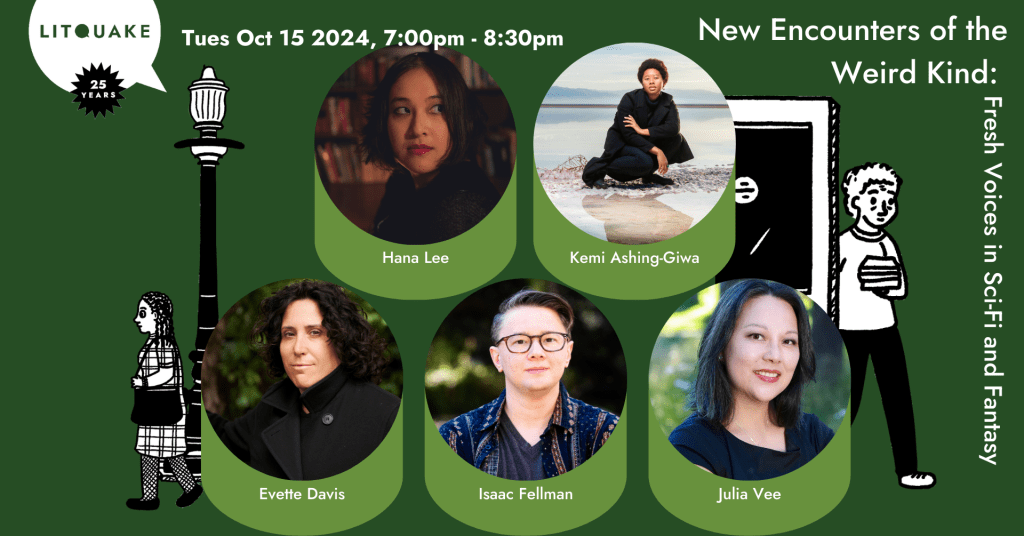
- I’m going to be hanging out with my friends and fellow authors Julia Vee and Hana Lee at LitQuake this year! We’ll be on the “New Encounters of the Weird Kind: Fresh Voices in Sci-fi and Fantasy” panel with Evette Davis and Isaac Fellman on 10/15 from 7-8:30PM at Telegraph Hill Books in San Francisco. You can grab a free ticket here.
- My very first published short story! Luna Station Quarterly recently published the revised reprint, “Jovis,” which you can read here. ↩︎
- To be clear, I have no interest in policing others’ relationships with media I myself enjoy. Just because someone enjoys reading about something in fiction does not mean they support it in real life. And at the end of the day, everyone’s entitled to their own opinions on media (and everything else). ↩︎
- It might be a bit of a stretch to call Villanelle a hero, but my point still stands, given that (SPOILERS) she’s killed taking down her far more evil bosses, and—more importantly—assassinated only a scene or two after finally getting together with Eve. ↩︎
 Kemi Ashing-Giwa
Leave a comment