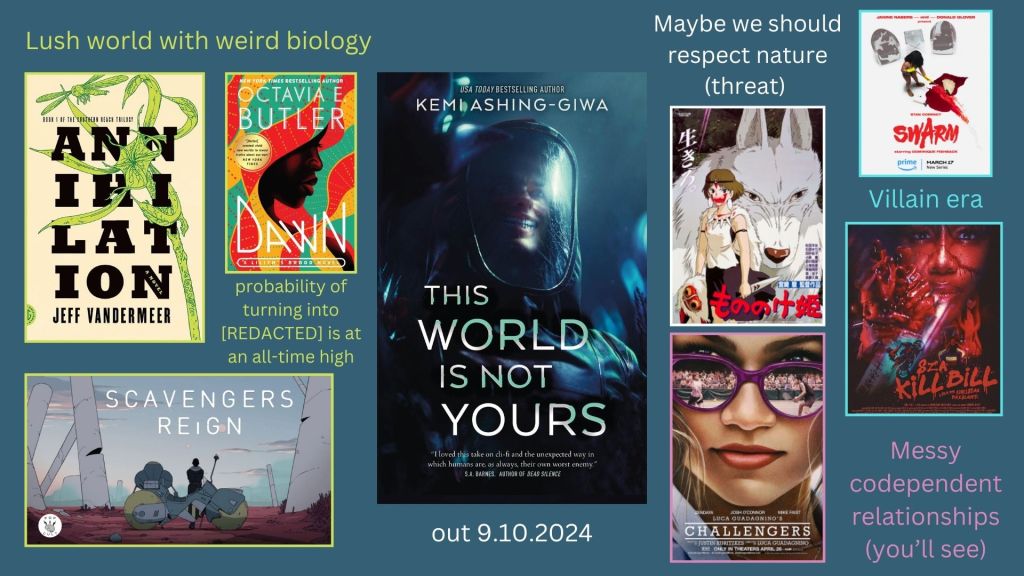
This World Is Not Yours hits shelves in just 10 days!
Here’s the cover letter we included in the ARCs:

If you weren’t able to snag an ARC, never fear! You can still preorder the novella here. (Was that smooth?) Barnes & Noble is also offering 25% off of all forthcoming print, eBook, and audio titles from 9/4-6. If you do preorder, remember to submit your receipt via this link to receive a high-res digital poster, along with three deleted scene snippets.
Events:
On 9/24, the one and only Charlie Jane Anders will be hosting a special one-off version of Writers with Drinks at Strut in San Francisco. I’ll be reading a bit of This World Is Not Yours, and I hope to see some of y’all there! I’ll share more details on my event page as they come.
I’m also going to be running my virtual workshop “Building Worlds: Crafting Credible Science-Fiction Settings” at Flights of Foundry again on 9/27 at 4PM PST. It’s entirely free, and you can sign up for the lottery here until 9/11. (You’ll need to register for the online convention first).
***
What’s new on the TBR:
- “Winter’s King” by Ursula K. Le Guin. I just found out about the short story sequel to The Left Hand of Darkness, and I’m really looking forward to reading it.
Some of what I’ve read recently:
- Shiver: Selected Stories by Junji Ito. This was absolutely terrifying. “Fashion Model” was my favorite story in the collection. I’d just suggest reading it during the day…
- Don’t Go Without Me by Rosemary Valero-O’Connell. I was right—this turned out to be one of my favorite graphic novels ever. The eponymous first story was the best, I think, but the second and third were fabulous too. Highly recommended.
credit where credit is due: a brief ramble on how we talk about famous scientists & on celebrating unsung contributions to science
A Short History of Nearly Everything by Bill Bryson. Some of the science is outdated, so keep an eye out for that if you choose to pick this book up. Whether you like A Short History or not will depend on how interested you are in the history of science, which I’d say is the book’s real focus. While the book occasionally tipped into long stretches of very male-centric hero worship (the author devotes whole chapters to praising both well-known and obscure men, but spends only a few sentences discussing Marie Curie and Rosalind Franklin), I liked learning about the often wacky personalities of the scientists behind some of the greatest discoveries ever made, as well as the occasional note about where and how they got things wrong.
At the North American Paleontological Convention earlier this year, I attended a plenary talk by Dr. Pedro Monarrez on the foundational roles of colonialism and systemic racism in paleontology, and on how to create a more inclusive discipline going forward. One of the points that really stuck with me is how describing scientists who’ve done groundbreaking work as untouchable geniuses—gods amongst men, once-in-a-myriad minds, etc. etc.—actively discourages people from engaging with science and pursuing their own careers in STEM. It would be ridiculous to say that the theory of natural selection, for example, wasn’t an incredible advance—but acknowledging that people like Darwin1 were human beings with a lot of resources (and time) is important too.2
So is honoring the (mostly) unsung developments made by marginalized and historically excluded people, and I wish Bryson had done a bit more of that. Did you know that the first accurate identification of vertebrate fossils in America was made by enslaved Africans, who recognized the similarities between mammoth and elephant molars? I sure didn’t, until grad school!
- By the way, naturalist Alfred Russell Wallace and Scottish gardener Patrick Matthew also independently developed their own versions of descent with modification—in fact, Matthew even came up with the theory twenty years before Darwin, but he published it in a book no one read. (Credit where credit is due: I wouldn’t have learned this fact if not for Bryson.) ↩︎
- Many of these scientists were actually quite humble about their accomplishments. Isaac Newton wrote in a letter to fellow polymath Robert Hooke: “If I have seen further it is by standing on the shoulders of giants.” ↩︎
 Kemi Ashing-Giwa
Leave a comment